Foot traffic shows how an in-store event changes visitor behavior across both mall-wide and zone-specific areas. Many managers struggle to prove which visitors arrived for the event and which followed routine movement patterns. Overhead people-counting systems that use image processing provide accurate baseline data, zone distribution and real-time lift.
When this information guides layout decisions, staff placement and event evaluation, it creates a consistent decision-making framework. Using foot traffic data to maximize the impact of your in-store events then becomes a repeatable process for planning, executing and measuring performance.
Why Traditional Event Metrics Fall Short
Most reports rely on partial signals that can’t show how the event influences movement across the space. They don’t reveal which areas gained traffic, how long people remained in front of certain displays or how people actually moved through the space.
Traditional reporting tools can’t separate mall-wide traffic changes from activity in specific zones. Without this separation, managers can’t tell whether the specific promotion lifted traffic across the property or only in a few corridors.
These methods miss space utilization in important areas and leave traffic flow as a blind spot. They can’t show how consumers moved around crowds, where movement slowed or how paths changed during peak periods.
Traditional reporting methods leave gaps when it comes to:
Showing how event activity affects store entry and conversion, not just raw headcounts.
Comparing performance across different formats using consistent, zone-level metrics.
Linking space utilization patterns to specific layout or staffing decisions.
Isolating event-driven shoppers from background traffic in a way management can trust.
Quantifying incremental lift in a repeatable way across multiple sites.
A 3-Step Framework for Measuring Event Success
This three-step framework brings structure to analysis, so that every in-store experience — from demo areas to sampling stations and workshop zones — is planned, measured and compared in the same way.
It turns scattered observations into a clear sequence:
Understand normal traffic.
Measure what changes during the activation.
Connect those changes to revenue and margin.
Step 1: Establish Your Baseline
A baseline captures the regular traffic patterns for each day and hour, revealing natural surges and consistent movement paths. Managers gather two to four weeks of overhead people-counting data to build accurate comparisons for the event window.
In practice, the baseline should capture:
Average daily and hourly traffic for each planned zone.
Peak periods and recurring crowd surges by day type.
Natural visitor paths and clustering points.
Typical staff demand by time and zone.
Step 2: Measure In-Event Traffic and Engagement
Incremental lift, calculated by comparing the activation traffic to the baseline, indicates the number of additional shoppers generated by the in-store event. Heat maps reveal where people congregate, how density shifts over time and how movement patterns adjust in response to the event’s layout.
During the event, focus on:
Tracking incremental lift versus the baseline for the same day and time window.
Monitoring hour-by-hour changes in zone traffic and space utilization.
Identifying which in-store experiences generate the highest concentration of people.
Adjusting staffing, entry points and micro activations when patterns shift.
Step 3: Calculate Your Event ROI
Your return-on-investment (ROI) assessment shows how traffic becomes revenue. The process begins by identifying incremental traffic lift for the activation period. Store entry counts show how many of those people moved into nearby stores.
A defined conversion rate is applied to estimate the group of people who made a purchase. Revenue is calculated using average transaction value and gross margin from point-of-sale (POS) systems.
Each input in the calculation has a specific role:
Incremental visitors: Additional attendees above the baseline
Store entry rate: Percentage of people who enter nearby stores from the event zone
Average transaction value: Mean purchase value for the specific period from POS data
Gross margin: Profit percentage applied to event-related transactions
Activation cost: All direct expenses tied to the experience
For example:
1,250 incremental visitors x 40% store entry rate = 500 store entries
500 store entries x 25% conversion rate = 125 transactions
125 transactions x $75 average value x 50% margin = $4,687.50 profit
($4,687.50 profit – $2,000 cost) / $2,000 = 134% ROI
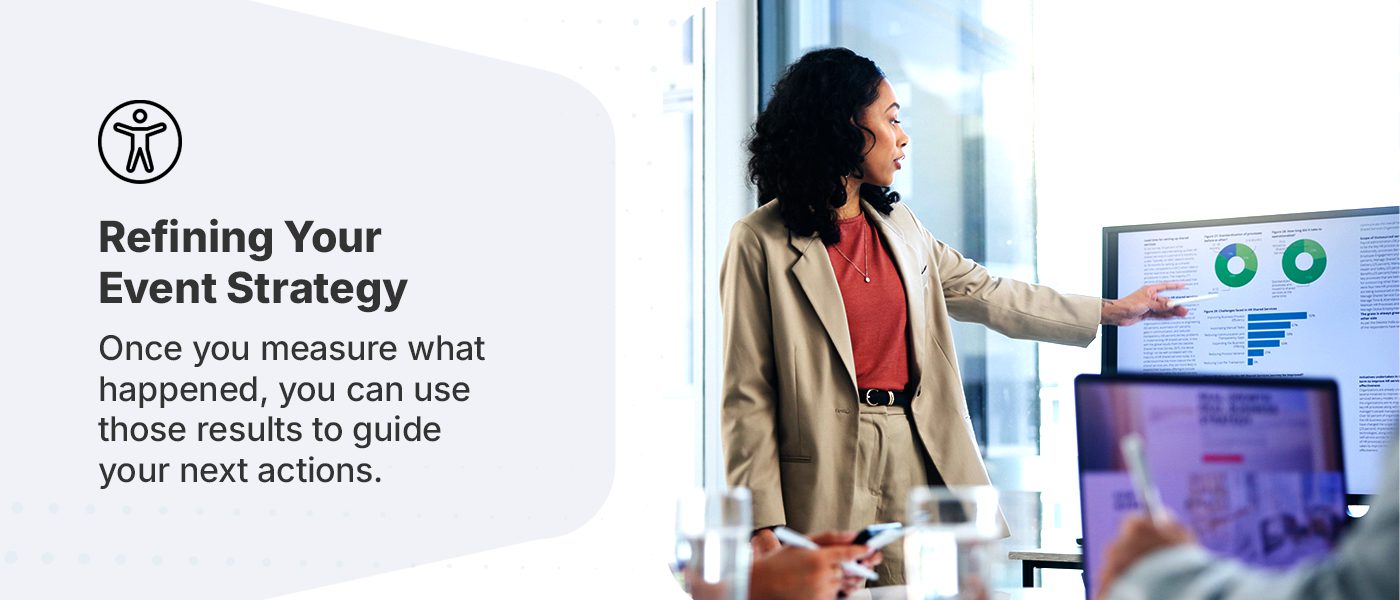
Refining Your Event Strategy
Once you measure what happened, you can use those results to guide your next actions. Decisions shift from one-off guesses to a cycle of testing, learning and refining future layouts and formats.
Use Heat Maps to Perfect Event Placement
Using heat maps can show where people cluster and how they move through the event or promotion area. Managers identify where the movement slows or breaks and which zones receive the least attention. This helps them decide which parts of the space should carry the most attention and which areas need more support.
To act on these insights, you can:
Maximize exposure by placing headline activations along the highest traffic paths.
Protect flow by aligning displays and queues with natural movement lines.
Activate cold zones by adding secondary experiences or sampling stations in underused areas.
Move quieter or premium experiences into calmer zones to improve space utilization quality.
Reorient queues and displays to reduce bottlenecks and preserve corridor flow.
Test layout changes across repeated events and compare heat maps to track improvement.
Identify Which Events Actually Drive Foot Traffic
Different event formats have varying effects on people. Some draw attention across the property while others only affect a single corridor or store. Measuring these differences shows which concepts deliver the strongest value.
Split-run testing (A/B) compares formats under similar conditions to reveal changes in lift, space use, store entry and sales conversions. Using consistent metrics makes it clear which formats to prioritize.
To compare different formats, track the following:
A/B tests that compare event types, such as workshops, product demos and service activations
Performance of seasonal holidays versus flash sales using the same foot traffic and sales metrics
Incremental visitors, store entries and sales conversion, not just raw turnout
Space utilization within the activation area
Revenue uplift and average transaction value during the event period
Why Your Data’s Accuracy Is Important
Without accurate people counting, lift and zone analysis quickly becomes a matter of guesswork. Systems that depend on device signals can’t confirm the number of individuals physically present. They often produce inconsistent counts when signals overlap, drop or duplicate.
Limits of Beacons and Wi-Fi
Signal-based systems like beacons and Wi-Fi measure devices, not people. Visitors carrying multiple devices may be counted more than once, while those with their devices turned off won’t be counted at all.
In practice, these systems often:
Miss individuals whose devices aren’t discoverable or connected.
Struggle to measure space use in dense areas where many signals overlap.
Leave gaps in traffic flow when visitors move through areas with weak or no coverage.
Strength of 3D Sensing
Overhead people-counting sensors that use image processing have up to 99% accuracy, even in dense crowds with varied speeds and directions. This supports event analysis with consistent, complete counts.
For operations teams, this means sensors can:
Count every individual within the sensor’s coverage, whether or not they carry a device.
Reduce false counts by distinguishing people from objects and fixtures.
Maintain consistent accuracy across changing light conditions and different environments.
Drive Measurable Results With Traf-Sys People Counters
By leveraging foot traffic data, managers can move from uncertainty to certainty, knowing the true impact of their events. This data empowers businesses to optimize their store layouts, which ensures the most effective use of space for higher customer engagement. With measurable insights, managers can calculate proven return on investment. This allows them to adjust strategies to drive greater sales.
Don’t base your in-store activation strategies on guesswork. Traf-Sys’ people-counting solutions provide the accurate data you need to measure traffic patterns, evaluate ROI and optimize your planning.
Contact us today for a free demo, and discover how our people-counting solutions can help you make informed decisions and drive measurable results.
Chris Wadsworth
Chris Wadsworth, president at Traf-Sys Inc., has over 20 years’ experience in the people counting industry. He holds the accomplishment of pioneering the use of wireless technology into people counting systems. He also worked extensively with the Nielsen company on the nationwide “PRSM” project to quantify and measure in-store shopping metrics. He led the development of the first complete web-based people counting software system platform.